

Rentdigi: How Do You Spot a Rental Scam in Canada? 9 Red Flags
Table of Contents
- 1. How common are rental scams in Canada?
- 2. What are the red flags of a rental scam?
- 3. 1. The price is too good
- 4. 2. They want a deposit before you've seen the place
- 5. 3. The landlord is away and can't meet
- 6. 4. You're being rushed
- 7. 5. Untraceable payment methods
- 8. 6. The photos appear somewhere else
- 9. 7. They won't sign a proper lease
- 10. 8. They ask for more than the law allows
- 11. 9. They want unusual personal information early
- 12. How do I verify a landlord before paying?
- 13. What should I do if I've already sent money?
- 14. FAQ
- 15. Is it normal for a landlord to ask for a deposit before a viewing?
- 16. Can a landlord ask for e-transfer payment?
- 17. How do I report a rental scam in Canada?
- 18. Are scams more common on certain sites?
- 19. Why verification matters
The surest sign of a rental scam is a request for money before you've seen the unit in person and confirmed the person renting it actually controls it. Most scams also share a price well below similar listings, pressure to decide fast, and a "landlord" who is conveniently out of the country. If a listing has two or more of these, stop and verify before you send anything.
How common are rental scams in Canada?
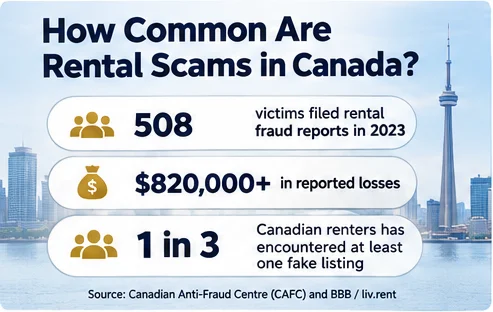
Common enough that most renters will run into one. The Canadian Anti-Fraud Centre (CAFC) reported that 508 victims filed rental fraud reports in 2023, with more than $820,000 in losses. A liv.rent report built on CAFC and Better Business Bureau data found that one in three Canadian renters has encountered at least one fake listing, and that while the number of reported scams dipped compared with 2024, victims who were caught lost more money.
Those figures understate the problem. The CAFC estimates that only 5% to 10% of all fraud in Canada is ever reported.
Students, newcomers and people moving from another city are targeted most, because they're often renting sight-unseen and on a deadline. If that's you, our cross-border renting checklist is worth reading too.
What are the red flags of a rental scam?
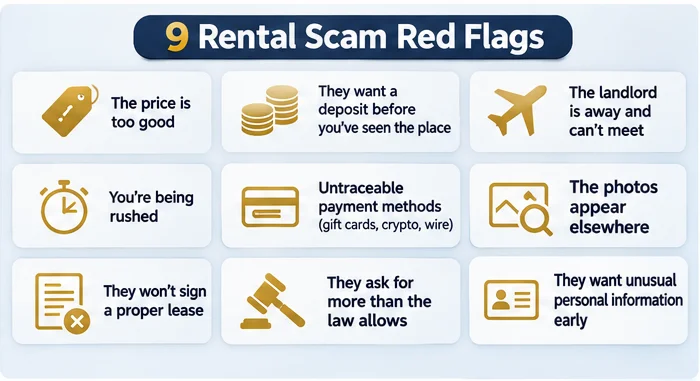
1. The price is too good
Scammers copy real listings and drop the price to draw a crowd. If a unit is noticeably cheaper than comparable places nearby, ask why. A quick check against current asking rents in the Rentdigi Rent Index will tell you whether a price is plausible.
2. They want a deposit before you've seen the place
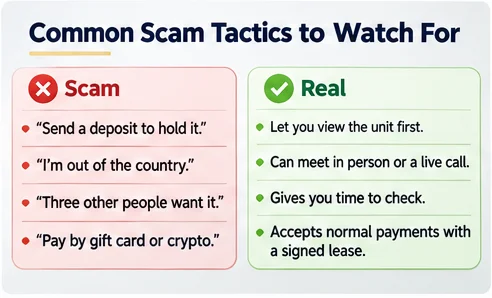
A legitimate landlord expects you to view the unit, in person or by a live video call, before taking money. "Send a deposit to hold it" is the single most common scam script.
3. The landlord is away and can't meet
Working overseas, on a mission trip, caring for a relative. The story varies, but the outcome is the same: you never meet anyone, and the keys will be "mailed" after you pay.
4. You're being rushed
"Three other people want it" or "I need an answer tonight." Pressure is designed to stop you from checking. Real landlords in a busy market do move quickly, but they won't refuse a showing.
5. Untraceable payment methods
Gift cards, cryptocurrency, wire transfers or e-transfers to someone you haven't met. Once that money is gone, it's very hard to recover.
6. The photos appear somewhere else
Run the listing photos through a reverse image search. If they show up on an old sale listing, a different city or a hotel site, walk away.
7. They won't sign a proper lease
Ontario requires its Standard Lease for most tenancies, BC requires a Residential Tenancy Agreement, and Quebec uses a mandatory lease form. A "landlord" who avoids paperwork is a warning sign.
8. They ask for more than the law allows
An Ontario landlord asking for a damage deposit, or a Quebec landlord asking for any deposit, is either unaware of the law or not a real landlord. Know your province's deposit rules before you pay anything.
9. They want unusual personal information early
Your SIN, banking passwords or a scan of your passport before you've even viewed the unit. Normal screening documents are covered in our guide to what landlords ask for before a lease.
How do I verify a landlord before paying?
Set aside about 20 minutes and confirm three things.
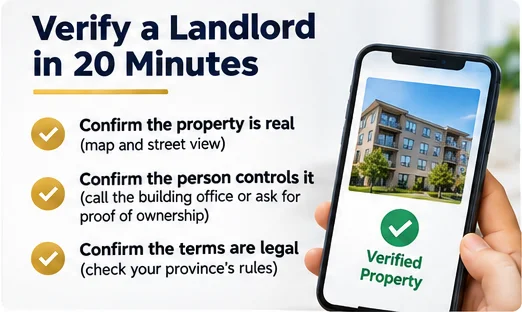
The property is real. Look up the address on a map and street view. Does the building match the photos?
The person controls it. For a building, call the management office using a number you found yourself, not the one in the listing. For a house or condo, ask for proof of ownership or a property management agreement, and check that the name matches. Ask to meet at the unit.
The terms are legal. Compare the deposit, fees and lease form against your province's rules.
If any of the three can't be confirmed, don't pay.
What should I do if I've already sent money?
Move quickly.
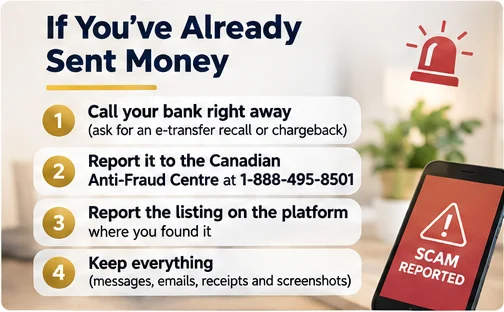
- Call your bank right away and ask for an e-transfer recall or chargeback.
- Report it to the Canadian Anti-Fraud Centre at 1-888-495-8501 and to your local police.
- Report the listing to the site where you found it, so it comes down before someone else pays.
- Keep everything: messages, emails, receipts and screenshots of the ad.
Recovery isn't guaranteed, but speed improves the odds, and your report helps police connect cases.
FAQ
Is it normal for a landlord to ask for a deposit before a viewing?
No. Legitimate landlords let you see the unit first, either in person or on a live video call where you can direct the camera. Paying to "hold" a unit you haven't seen is the most common way renters lose money.
Can a landlord ask for e-transfer payment?
Many legitimate landlords accept e-transfer for rent once you've signed a lease and confirmed who they are. The risk is sending one before that point. A payment method with a paper trail, and a signed lease first, is the safer order.
How do I report a rental scam in Canada?
Call the Canadian Anti-Fraud Centre at 1-888-495-8501 or report online, then file a report with your local police. Also flag the listing on the platform where it appeared.
Are scams more common on certain sites?
Scams appear wherever listings can be posted without checks. Platforms that verify landlords and listings reduce the risk, but no system is perfect, so always do your own verification before paying.
Why verification matters
Rentdigi was built around the idea that renters shouldn't have to play detective. Listings are subject to verification, and we flag patterns that match known scam scripts. Even so, the checks above are worth doing on any rental, anywhere. Trust is earned with proof, and a real landlord will be glad to give it.