


Rentdigi: How Much Is Tenant Insurance in Canada, and Do You Need It?

Table of Contents
- 1. How much does tenant insurance cost?
- 2. What does tenant insurance cover?
- 3. What isn't covered?
- 4. Can a landlord require tenant insurance?
- 5. How much coverage do I need?
- 6. How can I lower my premium?
- 7. FAQ
- 8. Is tenant insurance mandatory in Canada?
- 9. Does my landlord's insurance cover my stuff?
- 10. Does tenant insurance cover water damage?
- 11. Should roommates share one policy?
- 12. Budget for it from day one
Tenant insurance in Canada usually costs between $15 and $30 a month, and it's one of the best-value purchases a renter can make. Your landlord's insurance covers the building, not your belongings and not your personal liability. Tenant insurance fills both gaps, and many landlords now require it as a condition of the lease.
How much does tenant insurance cost?
Prices vary by province, city and coverage, but recent data puts most renters in a tight range:
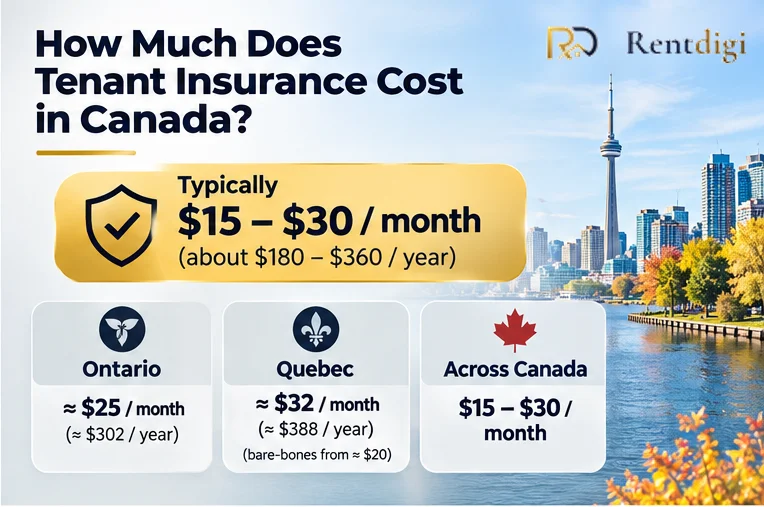
- Ontario: Rates.ca estimated the average Ontario tenant premium at about $302 a year in Q1 2026, roughly $25 a month. Downtown Toronto averaged about $313 a year.
- Quebec: KBD Insurance reported an average of $388 a year in 2026 with a $500 deductible, around $32 a month, with bare-bones policies near $20.
- Across Canada: most comparison sites and insurers quote a range of roughly $15 to $30 a month for a standard policy.
So for most renters, full coverage costs less than a streaming bundle. A building in an area without fire hydrants, a history of claims, or high-value items can push the price up.
What does tenant insurance cover?
A standard policy has three main parts.
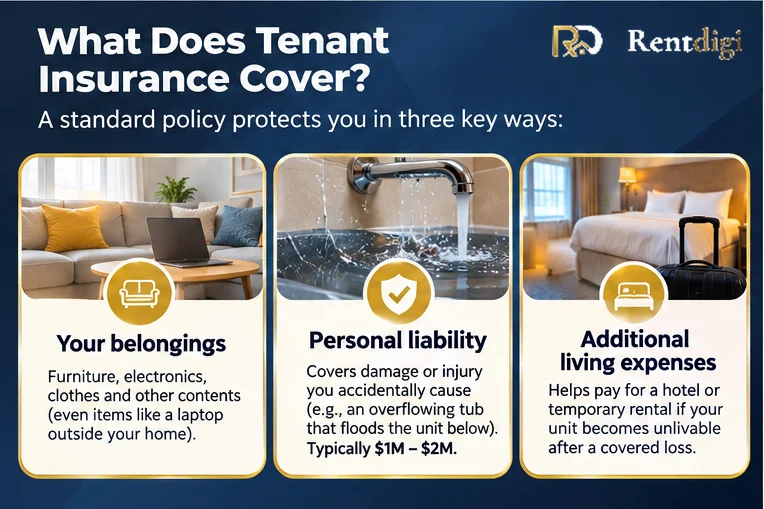
Your belongings. Furniture, electronics, clothes and other contents, whether they're damaged by fire, water from a burst pipe or stolen. This often extends to things you carry outside the home, like a laptop stolen from your car.
Personal liability. If you accidentally cause damage or injury, such as an overflowing bathtub that floods the unit below, liability coverage pays for the resulting claims and legal costs. Policies usually start at $1 million, and $2 million is increasingly common for a few dollars more.
Additional living expenses. If your unit becomes unlivable after a covered loss, the policy helps pay for a hotel or temporary rental while repairs happen.
What isn't covered?
Read the exclusions. Common gaps include:
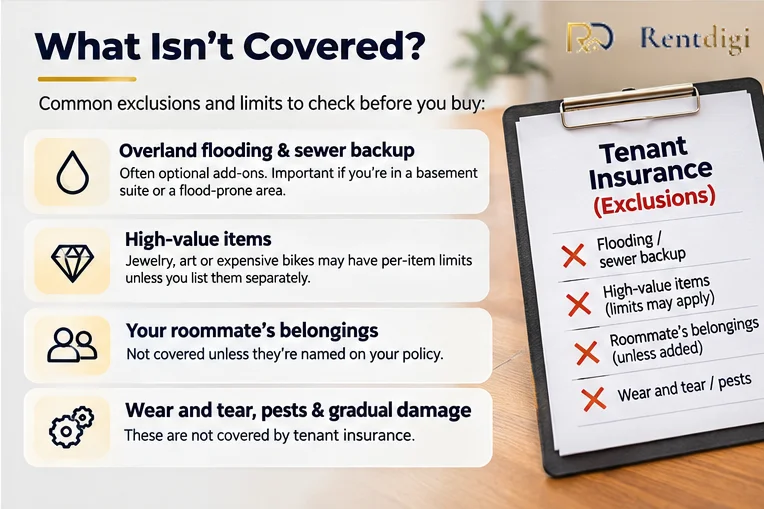
- Overland flooding and sewer backup, which are often optional add-ons. If you're in a basement suite, ask about these specifically.
- High-value items like jewelry, art or expensive bikes, which may have per-item limits unless you list them separately.
- Your roommate's belongings, unless they're named on your policy.
- Wear and tear, pests and gradual damage.
Can a landlord require tenant insurance?
In most provinces, yes. A landlord can make tenant insurance a condition of the lease, and it's increasingly standard in purpose-built rentals and condos. If your lease requires it and you don't carry it, you may be in breach of the agreement. It's one of the documents commonly requested before move-in, alongside the items in our guide to what landlords ask for before a lease.
Even when it's not required, it's worth having. Without liability coverage, a single accident can leave you personally responsible for thousands of dollars of damage to the building or a neighbour's unit.
How much coverage do I need?
Start with a quick inventory. Walk through each room and estimate what it would cost to replace everything at today's prices. Many renters are surprised that the total lands between $25,000 and $50,000 once clothes, kitchenware and electronics are counted.
Then decide on:
- Replacement cost vs. actual cash value. Replacement cost pays what it costs to buy new. Actual cash value subtracts depreciation, so a five-year-old sofa pays out far less. Replacement cost usually adds only a little to the premium.
- Deductible. A higher deductible lowers your monthly cost, but you pay more out of pocket when you claim.
- Liability limit. $1 million is the floor. $2 million is worth considering, especially in a multi-unit building.
How can I lower my premium?
- Bundle with car insurance through the same company.
- Raise your deductible if you have savings to cover it.
- Ask about discounts for smoke detectors, sprinklers, a monitored alarm or a claims-free history.
- Compare quotes each year at renewal. Prices for identical coverage can vary meaningfully between insurers.
FAQ
Is tenant insurance mandatory in Canada?
No law requires it, but landlords can make it a lease condition in most provinces, and many do. If your lease requires it, not having it can put you in breach of the agreement.
Does my landlord's insurance cover my stuff?
No. A landlord's policy covers the building and the landlord's own property and liability. Your belongings and any damage you cause are your responsibility, which is what tenant insurance covers.
Does tenant insurance cover water damage?
Sudden water damage, like a burst pipe or an appliance leak, is usually covered. Overland flooding and sewer backup are often add-ons, so check your policy if you live in a basement or flood-prone area.
Should roommates share one policy?
Some insurers allow it, but separate policies are usually simpler. A shared policy means a claim by one person affects everyone's record, and it can get complicated if one roommate moves out.
Budget for it from day one
When you're comparing rentals, add tenant insurance to the monthly cost alongside rent and utilities. It's a small line item that protects everything else you own. You can use the Rentdigi Rent Index to check that the rent itself is fair, then build your full budget from there.