


Rentdigi: How Much Can a Landlord Raise Rent in Canada in 2026?
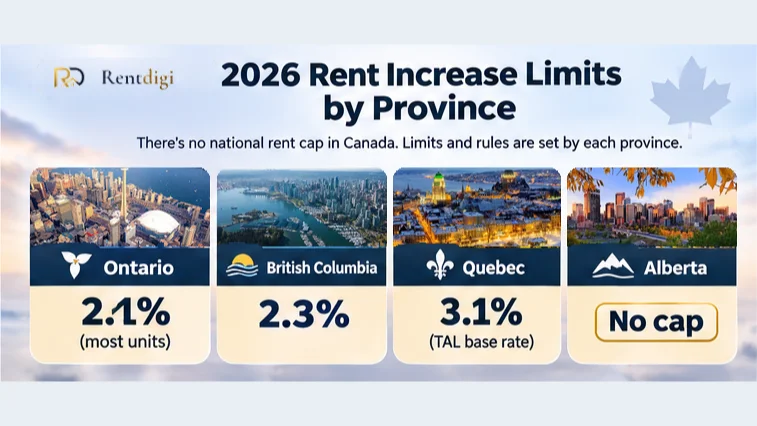
Table of Contents
- 1. What is Ontario's rent increase limit for 2026?
- 2. How much can rent go up in BC in 2026?
- 3. How do rent increases work in Quebec?
- 4. Is there rent control in Alberta?
- 5. What about the other provinces?
- 6. How do I check whether my rent increase is legal?
- 7. FAQ
- 8. What is the maximum rent increase in Ontario for 2026?
- 9. Can my landlord raise my rent when I sign a new lease?
- 10. Can I refuse a rent increase in Quebec?
- 11. Does the rent cap apply to a new tenant?
- 12. Know your number before you renew
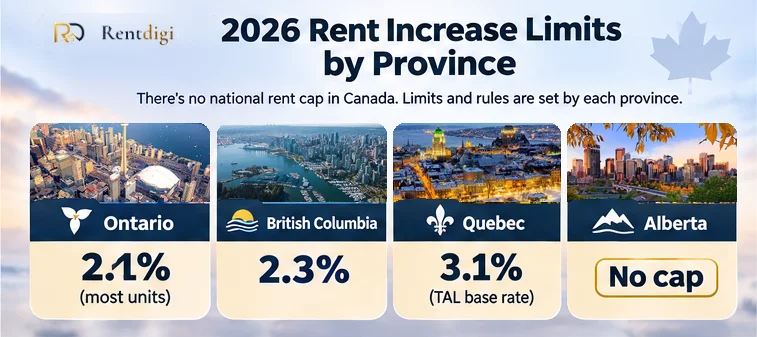
In 2026, the most a landlord can raise rent depends entirely on your province. Ontario's guideline is 2.1% for most units, British Columbia's cap is 2.3%, Quebec's tribunal uses a 3.1% base rate for most renewals, and Alberta has no cap at all. Every province limits how often rent can go up and how much notice you must get, so even where there's no percentage limit, there are still rules.
Canada has no national rent cap. Tenancy law is provincial, which is why two renters paying the same rent in Toronto and Calgary can face very different increases this year.
What is Ontario's rent increase limit for 2026?
Ontario set its 2026 rent increase guideline at 2.1%, according to the Ministry of Municipal Affairs and Housing, and it applies to increases taking effect between January 1 and December 31, 2026. The guideline is tied to Ontario's Consumer Price Index and, by law, can't exceed 2.5%.
On a $2,000 rent, that's a maximum increase of $42 a month.
The rules that come with it:
- Once every 12 months. Your landlord can't raise rent more often than that.
- 90 days' written notice, on the proper form (N1 for most tenancies).
- Above-guideline increases need approval from the Landlord and Tenant Board, usually for major capital repairs or big jumps in property taxes.
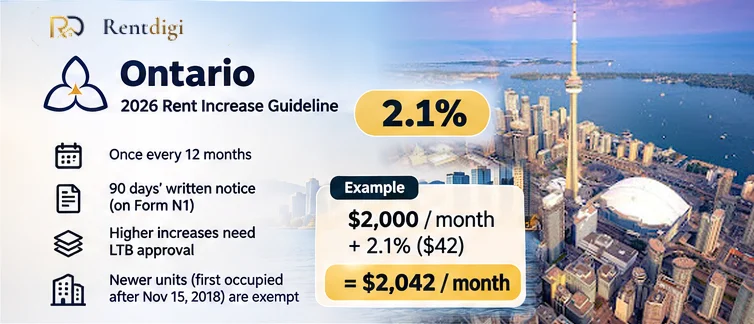
The big exception: units first occupied for residential purposes after November 15, 2018 are exempt from the guideline. If you live in a newer building, your landlord can propose any increase, though the 12-month and 90-day rules still apply. Ask about the building's first-occupancy date before you sign. Our Toronto renting guide covers this in more detail.
How much can rent go up in BC in 2026?
British Columbia's maximum allowable increase for 2026 is 2.3%, down from 3% in 2025. It's calculated from BC's 12-month average inflation rate and covers almost every residential tenancy in the province.
On $1,800 a month, the legal maximum is $41.40, for a new rent of $1,841.40. Landlords can't round up.
Landlords must give three full months' written notice on the approved Notice of Rent Increase form, and only once every 12 months. A higher increase is only possible through an application to the Residential Tenancy Branch.
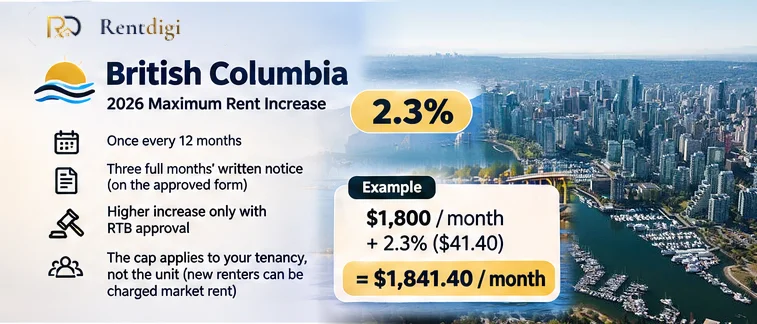
One thing BC renters often miss: the cap applies to your tenancy, not to the unit. When a tenant moves out, the landlord can set any price for the next renter. That's part of why Vancouver asking rents don't track the 2.3% figure.
How do rent increases work in Quebec?
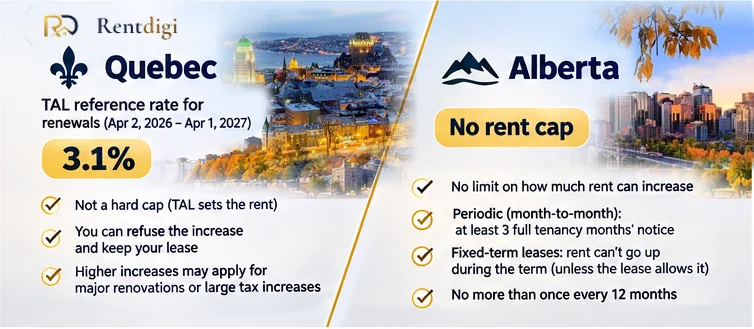
Quebec doesn't set a hard cap. Instead, the Tribunal administratif du logement (TAL) publishes reference percentages, and since January 1, 2026 it uses a new, simpler method based on the three-year average of Quebec's Consumer Price Index.
For leases renewing between April 2, 2026 and April 1, 2027, the base percentage is 3.1%. For leases that renewed on or before April 1, 2026, it was 4.5%. Both are well below the 5.9% figure the TAL published in early 2025, which was the highest in more than three decades and prompted the reform.
What's distinctive about Quebec is that tenants can refuse a proposed increase and keep their lease. If you refuse, the landlord has to apply to the TAL, which then fixes the rent using its official formula. Reasons a landlord might get more than the base rate include major renovations or large tax increases.
Is there rent control in Alberta?
No. Alberta has no limit on how much rent can increase. What it does regulate is timing:
- Periodic (month-to-month) tenancies: at least three full tenancy months' written notice.
- Fixed-term leases: rent can't go up during the term unless the lease allows it. A new rate can be set when you sign a new lease.
- Frequency: no more than once every 12 months.
Because there's no cap, Alberta renters should compare any increase against current asking rents. Calgary asking rents have been falling this year (see our 2026 Calgary rent breakdown), which gives you real room to negotiate at renewal.
What about the other provinces?
Manitoba sets an annual guideline, and several Atlantic provinces have used temporary caps in recent years. Rules change often, so check your provincial tenancy office directly before you agree to anything.
How do I check whether my rent increase is legal?
Run through four questions:
- Has it been 12 months since your last increase, or since you moved in?
- Did you get the right notice period, in writing, on the required form?
- Is the amount within your province's limit, and does your unit qualify for an exemption?
- Did the landlord get tribunal approval for anything above the limit?
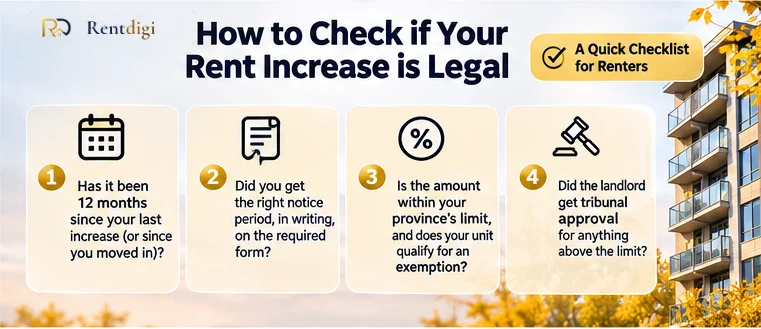
If the answer to any of these is no, you generally don't have to pay the extra. Contact your provincial board (LTB in Ontario, RTB in BC, TAL in Quebec) before withholding anything, and keep paying your current rent in the meantime.
It also helps to know what similar units are renting for. The Rentdigi Rent Index shows live asking rents by city, so you can tell whether a renewal offer is fair or whether moving would save you money.
FAQ
What is the maximum rent increase in Ontario for 2026?
The 2026 guideline is 2.1% for most rent-controlled units. It applies to increases between January 1 and December 31, 2026. Units first occupied after November 15, 2018 are exempt from the guideline but still require 90 days' notice and only one increase per year.
Can my landlord raise my rent when I sign a new lease?
In Ontario and BC, signing a new fixed-term lease with the same landlord doesn't reset the cap. The guideline and notice rules still apply. In Alberta, a new rate can be set when a new lease starts because there's no cap.
Can I refuse a rent increase in Quebec?
Yes. You have one month after receiving the notice to refuse, and you keep your right to stay in the unit. The landlord must then ask the TAL to set the rent, which it does using its official calculation method.
Does the rent cap apply to a new tenant?
Generally no. In BC and Ontario, the cap limits increases for a sitting tenant. Once a unit is vacant, the landlord can set a new market rent for the next person, which is why asking rents can move faster than the guideline.
Know your number before you renew
A fair renewal starts with knowing two things: your legal limit and what comparable units actually cost. Rentdigi's verified listings and Rent Index give you the second half of that picture, so you can negotiate from facts rather than guesses.