


Rentdigi: Renting in Toronto 2026: Costs, Neighbourhoods & Red Flags
Table of Contents
- 1. What Does It Cost to Rent in Toronto in 2026?
- 2. The Costs Nobody Advertises
- 3. Why Your Leverage Is Fading
- 4. How Toronto Compares
- 5. Toronto Neighbourhoods by Budget
- 6. Ontario Rules Every Toronto Renter Must Know
- 7. Red Flags: How to Spot a Rental Scam
- 8. How to Win a Toronto Lease
- 9. FAQs: Renting in Toronto
- 10. How much does it cost to rent in Toronto in 2026?
- 11. What is the cheapest place to rent in Toronto?
- 12. How much can my landlord raise the rent in Ontario in 2026?
- 13. Is a security deposit legal in Ontario?
- 14. How do I spot a Toronto rental scam?
- 15. Find a Fairly-Priced Toronto Rental Today
Last updated: July 2026
Renting in Toronto costs about $2,400 per month on average in 2026 — roughly 23% above the Canadian average. A one-bedroom typically runs $1,950–$2,400 and a two-bedroom $2,500–$2,900, before the $150–$350 a month that utilities and tenant insurance add on top.
Toronto renters have spent two years in the strongest bargaining position they've had in a decade. That window may be closing.
After 29 straight months of annual rent declines, Toronto asking rents have now risen for three consecutive months. Annual declines have narrowed to under 2%, and analysts are calling it an early signal that the correction is ending.
This guide covers what you'll actually pay by neighbourhood, what Ontario law entitles you to, and the warning signs that separate a good deal from a stolen deposit — using data from the Rentdigi Rent Index, which tracks asking rents across verified listings.
What Does It Cost to Rent in Toronto in 2026?
The cost of renting in Toronto breaks down by unit type like this:
| Unit type | Typical monthly range (2026) | What the low end usually means |
|---|---|---|
| Studio / bachelor | $1,600 – $1,850 | Older building, or outside the core |
| 1 bedroom | $1,950 – $2,400 | Scarborough, north Etobicoke, or a walk-up |
| 2 bedroom | $2,500 – $2,900 | Below ~$2,500 usually means suburban or utilities excluded |
| 3 bedroom / house | $3,300 – $3,800 | Farther from a subway line |
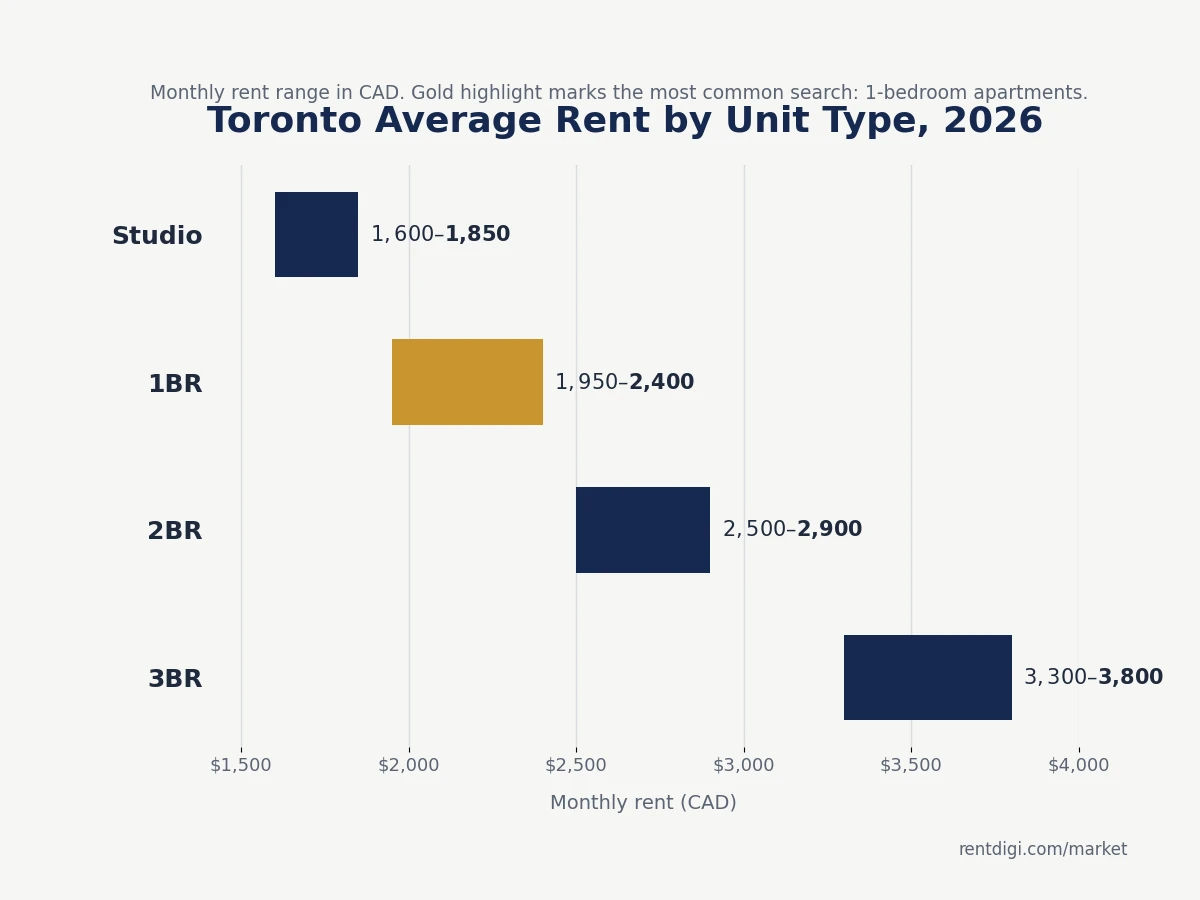
Toronto's overall average sits around $2,400 per month, roughly 23% above the national average. Ranges above are asking rents drawn from the Rentdigi Rent Index, which tracks live verified listings rather than survey estimates, and are current as of July 2026.
The Costs Nobody Advertises
Rent is roughly 80–85% of what you'll actually spend on housing. Budget for:
- Utilities and internet: $150–$350/month. A bachelor with heat and water included might add only $75–$100. A three-bedroom where you pay everything can hit $300–$400 in winter.
- Tenant insurance: commonly required by the lease, usually $20–$40/month.
- Elevator booking fees — standard in Toronto condos, and often refundable only if you book a window properly.
- First and last month's rent up front. A $2,100 one-bedroom means $4,200 before you get keys.
Real budget check: a $2,100 one-bedroom is realistically a $2,350–$2,450/month commitment once utilities and insurance are counted.
Why Your Leverage Is Fading
Rents fell hard through 2025 and early 2026 — Toronto saw the steepest declines of Canada's six largest markets. Then they turned: three consecutive monthly increases through June.
Incentives are still widespread. Industry data shows incentive availability in purpose-built GTA buildings roughly doubled between early 2024 and early 2025 and stayed above 60% through the year, with two months of free rent the most common single offer.
But the discount phase is maturing. If you're renting in the next few months, negotiate now rather than waiting for a better market that may not arrive.
How Toronto Compares
- Calgary — comparable units run 33–45% cheaper.
- Edmonton — averages around $1,350. A Toronto bachelor often costs more than an Edmonton two-bedroom.
Toronto Neighbourhoods by Budget
Toronto rent is governed less by neighbourhood charm than by distance from a subway line.
| Tier | Areas | 1-bedroom range | Trade-off |
|---|---|---|---|
| Premium | Downtown core, waterfront, Yorkville | $2,400 – $2,650 | You pay for the commute you don't make |
| Strong value | Midtown, Willowdale, East York | $2,100 – $2,450 | Subway access, less nightlife |
| Best value | Scarborough, north Etobicoke | $1,700 – $2,000 | 45–60 min commute, saves $500–$800/mo |
| Cheapest | Basement suites, shared housing | $1,200 – $2,000 | Verify the suite is legally registered |
Premium — downtown core, waterfront, Yorkville. Union Station-adjacent one-bedrooms run roughly $2,400–$2,650, and Yorkville averages well over $4,000. You're paying for the commute you don't have to make.
Strong value — Midtown, Willowdale, East York. Willowdale along North York's Yonge corridor is a second downtown with subway access and one-bedrooms around $2,100–$2,250. Midtown runs $2,250–$2,450.
Best value — Scarborough and north Etobicoke. This is where Toronto becomes affordable. Scarborough near Kennedy or Warden offers one-bedrooms at $1,700–$2,000; Etobicoke along the Bloor–Danforth line has two-bedrooms at $2,200–$2,500 — roughly what a bachelor costs downtown. The trade-off is a 45–60 minute commute, but the saving is often $500–$800 a month.
Cheapest — basement suites and shared housing. Basement apartments range from about $1,200 for a basic bachelor to $2,000+ for a renovated two-bedroom. Verify the unit is legally registered with the city before signing — unregistered suites leave you with little recourse.
Watch the Eglinton Crosstown corridor. Purpose-built construction has concentrated along the LRT line, and rents there are still catching up to the transit access.
Browse apartments for rent or see every verified listing in Toronto.
Ontario Rules Every Toronto Renter Must Know
1. Rent control exists — but there's a trap. Ontario's 2026 rent increase guideline is 2.1%, with a maximum of one increase every 12 months and 90 days' written notice. But the guideline only applies to units first occupied on or before November 15, 2018. Units first occupied after that date — new condos, new purpose-built buildings, basement suites created after that date — are completely exempt, and the landlord can raise rent by any amount with proper notice.
Ask this in writing before you sign: "Was this unit first occupied for residential purposes before or after November 15, 2018?"
2. Security deposits are illegal in Ontario. Your landlord may legally collect only:
- First month's rent
- Last month's rent (applied to your final month, earns interest annually, and cannot be used for damages)
- A refundable key deposit equal to the actual replacement cost of the keys
A "damage deposit," "cleaning deposit" or "pet deposit" is not legal in Ontario. Anyone asking for one is either breaking the law or running a scam.
3. Your landlord can't just walk in. Entry requires 24 hours' written notice, between 8 a.m. and 8 p.m., except in genuine emergencies.
4. Vacancy decontrol explains the jumps. Even in a rent-controlled building, a landlord can set any rent for a new tenant — which is why the unit down the hall from a long-term tenant may list for $700 more.
5. The LTB is your recourse. Most tenant applications cost about $53 through the Tribunals Ontario Portal. Be realistic about backlogs: file early and document everything from day one.
This section is general information, not legal advice. For advice on your own tenancy, contact the Landlord and Tenant Board or a licensed paralegal.
Red Flags: How to Spot a Rental Scam
Toronto's competitive market makes it a prime target for rental fraud, and nearly every scam depends on one thing — urgency. If you act fast, you don't think.
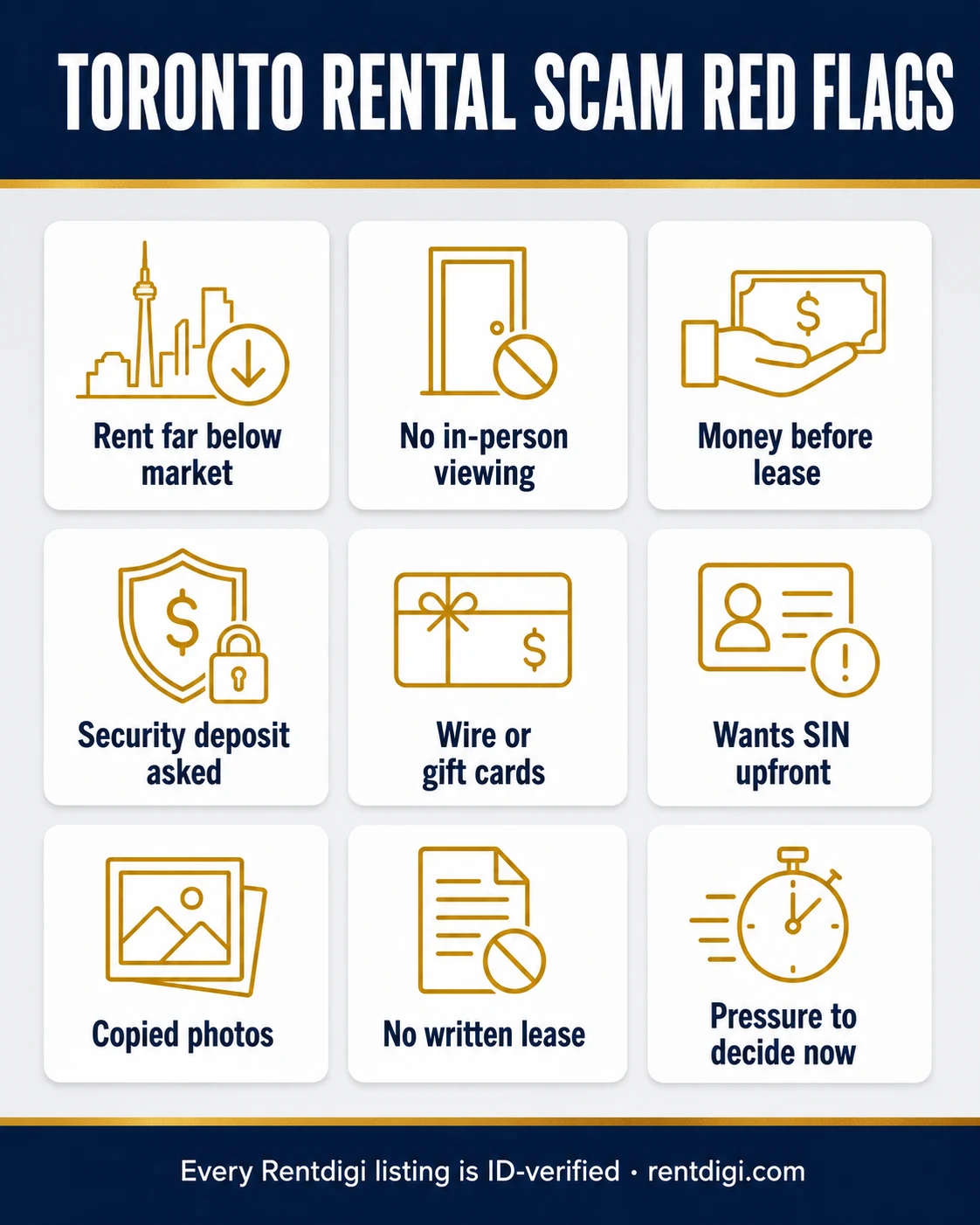
Walk away if you see:
- Rent well below market for the area. Check it against the Rent Index first. A suite $600 under the local median is bait, not a bargain.
- No in-person viewing. "I'm overseas for work" or virtual-only tours are a serious warning sign in 2026.
- Money requested before a lease is signed. Deposits come after paperwork, never to "hold" a unit you haven't seen.
- A request for a security or damage deposit. Illegal in Ontario — an instant disqualifier.
- Unusual payment methods — wire transfer, Western Union, gift cards, crypto.
- Requests for your SIN or banking login before any application is signed.
- A copied listing. Reverse image search the photos. Same photos under a different name or price means a scam.
- No lease, or an incomplete one. Most private Ontario tenancies use the province's standard lease form.
- Pressure to decide tonight. Real landlords screen tenants; they don't run auctions over text.
Your five-minute check: reverse image search the photos, Google the address, confirm the landlord's name against the property owner, insist on seeing the actual unit, and pay only after you've signed a complete lease.
If you've been scammed, report it to the Canadian Anti-Fraud Centre, Toronto Police, and the platform where you found the listing — and contact your bank immediately.
How to Win a Toronto Lease
Even in a softer market, well-priced units attract multiple applicants. Have your package ready before you view: photo ID, proof of income, a credit report (you can pull your own free), previous landlord references, and a completed application.
No Canadian credit history? Common for newcomers and students. Offer a co-signer, additional proof of funds, or a longer term. You cannot be legally required to prepay extra months.
And negotiate. With incentives still available, ask for a free month, a lower rent for a longer term, included parking or storage, or a capped increase if the unit is exempt from rent control.
FAQs: Renting in Toronto
How much does it cost to rent in Toronto in 2026?
The average rent in Toronto is around $2,400 per month in mid-2026, roughly 23% above the national average. One-bedrooms typically run $1,950–$2,400 and two-bedrooms $2,500–$2,900, plus $150–$350 monthly for utilities and internet.
What is the cheapest place to rent in Toronto?
Scarborough near Kennedy and Warden stations and north Etobicoke offer the best value, with one-bedrooms from about $1,700–$2,000. Expect 45–60 minute commutes downtown in exchange for savings of $500–$800 a month.
How much can my landlord raise the rent in Ontario in 2026?
The 2026 guideline is 2.1%, with 90 days' written notice and a maximum of one increase every 12 months. This applies only to units first occupied on or before November 15, 2018. Units first occupied after that date are exempt, and the landlord may raise rent by any amount with proper notice.
Is a security deposit legal in Ontario?
No. Landlords may collect first and last month's rent plus a refundable key deposit equal to the actual replacement cost of the keys. Security, damage, cleaning and pet deposits are not legal in Ontario.
How do I spot a Toronto rental scam?
The strongest signals are rent well below market, refusal to allow an in-person viewing, requests for money before a lease is signed, requests for a security deposit, unusual payment methods, and pressure to act immediately. Reverse image search the photos and verify the address before paying anything.
Find a Fairly-Priced Toronto Rental Today
Every listing on Rentdigi is verified, shows all-in pricing, and can be checked against live market data — so the number you see is the number that's real. Browse rentals in Toronto or check what your rent should cost before you sign.